4
Inductive Sensors
Inductive proximity sensors generate a magnetic field from their
detection faces. Whenever a detectable object moves into the sensor’s
field of detection, Eddy currents build up in the target and dampen the
sensor’s magnetic field. This effect triggers the sensor’s output. Since a
current in the target is needed for detection, inductive proximity sensors
are uniquely suited for detection of all types of metals.
ADVANTAGES
-Not affected by humidity and dust
-No moving parts, no mechanical wear
-Independent of the color of the object to detect
-No dead zone
DISADVANTAGES
-only detect metallic objects
-low operating distance
-sensitive to electromagnetic interference
(such as electric welding, induction ovens)
Shielded models - FLUSH mounting
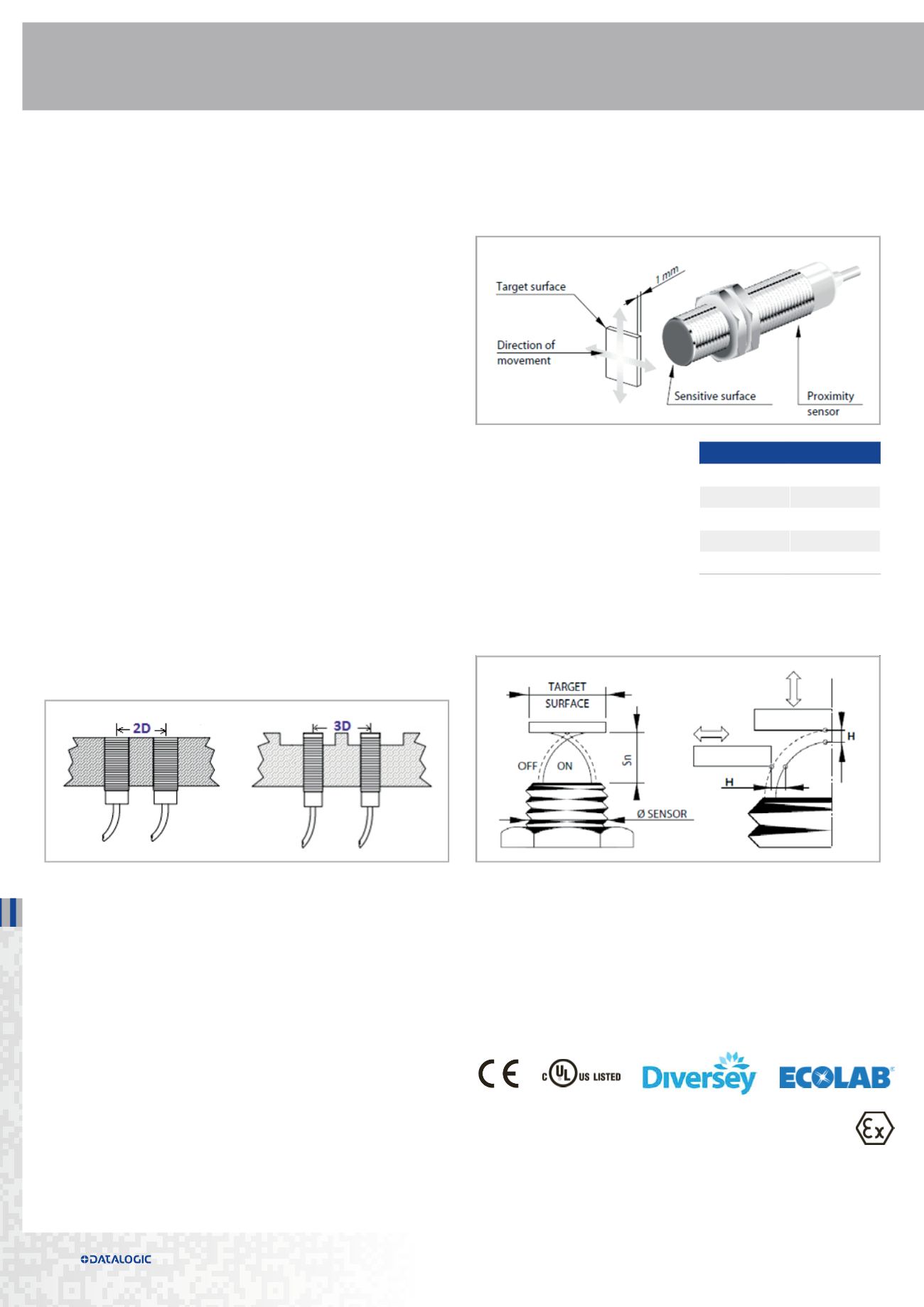
Shielded models can be installed with their sensing faces flush to the
metal. The distance from opposing metal surfaces must be ≥ 3sn and
the distance between two proximity switches (side-byside) ≥ 2D.
Unshielded models - NON-FLUSH mounting
Unshielded models can be identified by their ‘caps”, since they have no
metal housing surrounding the area of the sensing face. The sensing
face must extend ≥ 2sn from the metallic installation medium. The
distance from opposing metal surfaces must be ≥ 3sn and the distance
between two adjacent proximity switches ≥ 3D. The metal body leaves
uncovered part of the sensing area resulting in an increased sensing
distance.
Main tubular models are available in both nickel plated brass and
stainless steel housing, with the active sensing face in LCP plastic.
METAL FACE version:
Are available stainless steel versions (M12,M18).
Are used in especially harsh environments and applications which
are too extreme for standard sensors. They resist to abrasive media,
aggressive cleaners and solvents with their rugged sensing face. IP67
protection.
WELD FIELD IMMUNE version:
These special field immune models are ideal for welding environments
and other applications where large magnetic fields are present. They are
rated for reliable operation near the current line carrying 20,000 amps.
NAMUR version:
Are available 2 wires versions (M5, M6,5, M8, M12, M18, M30). They can
be used in conjunction with suitable switching amplifiers, in explosive
systems or Zone 1 and Zone 2 areas.
The switch amplifier must be installed outside the explosive area.
Almost all versions have IP67 mechanical protection.
Nominal Switching distance (Sn) According to EN 60947-5-2
When an inductive proximity sensor is rated for sensing distance, it
refers to the sensor’s ability to detect the “standard detectable object”
at its specified sensing distance. The “standard detectable object” is a
1mm thick square piece of ferrous iron that is in height and width the
size of the proximity sensor’s detection face’s diameter.
Hysteresis (H):
distance between the point of switching on and the point of switching
off of the trigger object. The value is a percentage of the nominal
switching distance Sn.
AC/DC version:
Are available 2/3-wires versions (M12, M18, M30) , that operate in
alternating current with voltage drop of 5 V for currents of the order of
100mA.
To be able to provide a proper potential drop at the load, it is
recommended to power the sensors with at least a supply voltage equal
to the Voltage drop indicated (5V).
When the object to be detected is
a different metal material, multiply
the value of the rated operating
distance for a reduction factor.
The table beside shows the
reduction factors of the main
metals used in industry.
REDUCING FACTOR
Fe37
1 x Sn*
Stainless-steel
0,9 x Sn
Brass-Bronze
0,5 x Sn
Alluminium 0,4 x Sn
Copper
0,3 x Sn
M12/18/30 FLUSH models are ATEX certified
I I 3G EX nA II T6
I I 3D EX tD A22 IP67 T85°C
“M12/18/30 models are Diversey and ECOLAB tested”


